I build with AI for a simple reason: it lets me stay close to messy problems long enough to turn them into working systems.
That matters to me because building through layers of translation is expensive. A lot of energy disappears into turning a rough idea into tasks, follow-ups, context handoffs, and management loops before the real work even starts.
Over the last few weeks, I have been pairing that builder instinct with a different kind of work: talking to transport operators about where their day actually leaks time, money, and attention. The pattern that keeps coming back is not "we need more AI." It is "we need fewer blind spots, fewer repetitive follow-ups, and clearer signals about what really needs a human."
Why I Build With AI
What clicked for me with AI was not hype. It was the ability to open a messy problem, explain what I see, argue with the system, change direction, and keep building without turning every thought into a management process first.
That is how I ended up building small automations, bots, reports, context-aware drafting tools, and eventually agent-based systems that can work inside a shared operating environment.
The honest motivation is not glamorous: I want to use AI to make life easier, improve how a company works, and build things that can earn more or waste less.
The Real Question Behind Check-Calls
One operator pattern stuck with me immediately. "Where is the truck?" is usually not the real question.
The real question is: "Do I need to step in?"
When a manager or dispatcher has to keep calling drivers or carriers just to confirm that normal movement is still normal, the cost is not only time on the phone. The cost is that routine work and risky work start to look the same until someone manually checks. That is an attention problem.
What the operator actually needs
A useful AI system here is not "track everything forever." It is "show me what needs intervention now."
- Late
- Unconfirmed
- Off-plan
- Missing location
- Needs a human decision now
Empty Kilometers Are Not Just a KPI
Another theme from operator interviews was empty kilometers. I do not see that as an abstract utilization metric. I see it as unpaid truck movement.
Fuel still burns. Driver time still gets spent. Equipment still wears down. And the bigger cost is often the next paid load you were not positioned to take because the vehicle finished in the wrong place at the wrong time.
What makes this hard is that the loss does not always show up as one clean number. It shows up across routing, timing, vehicle position, order constraints, and planning choices. That is exactly the kind of mess where AI can be useful if it translates operational leakage into money, tradeoffs, and next decisions instead of another dashboard nobody trusts.
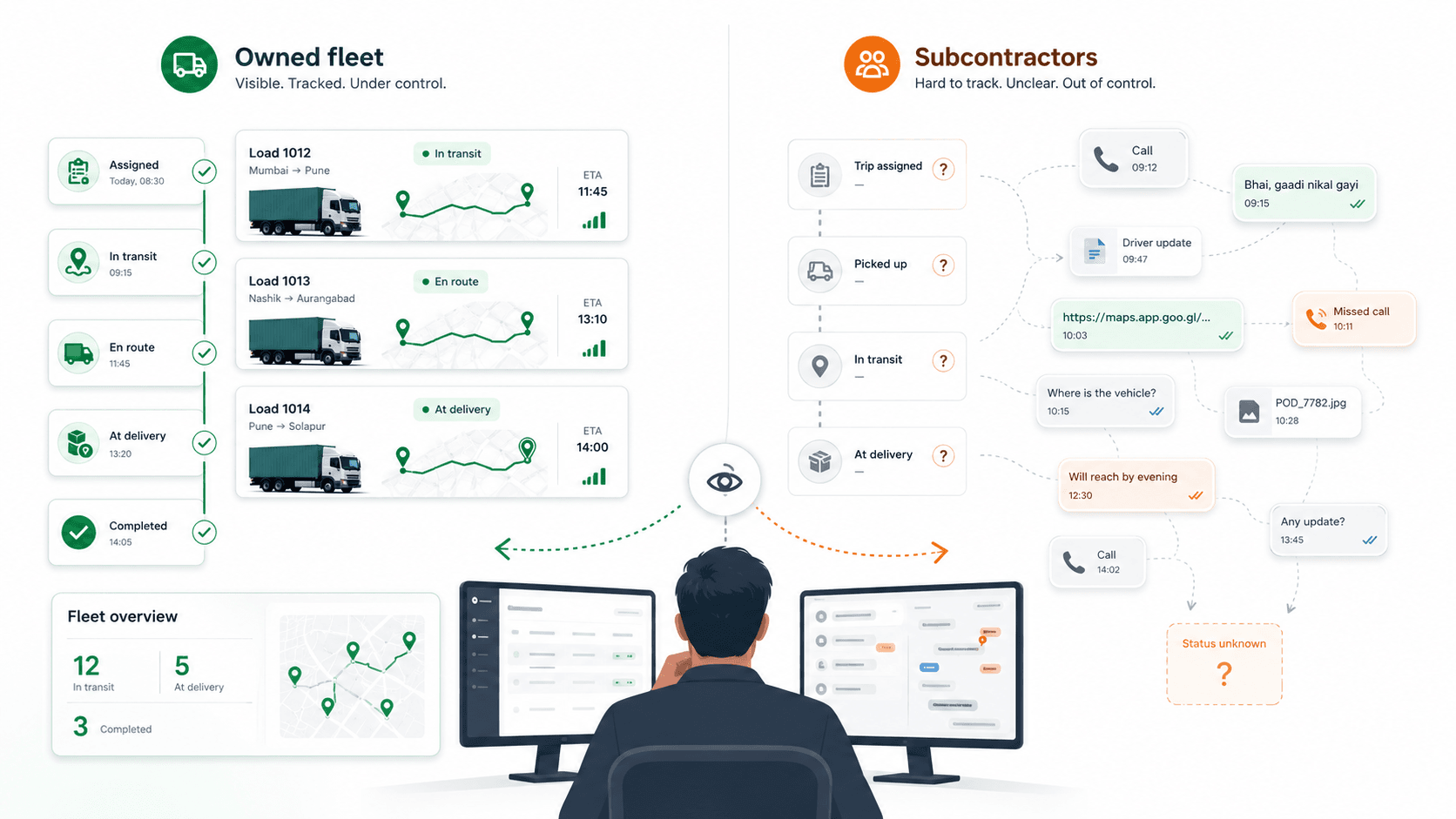
A similar blind spot appears when the owned-fleet side of the job looks tracked, but the subcontractor side still runs on calls, links, and hope.
That split matters because the hidden cost is dispatcher attention. If visibility breaks down exactly where control ends, people end up chasing normal updates because they cannot reliably see which load is actually late, unconfirmed, off-plan, or missing location.
AI is only helpful here if it reduces that checking burden and surfaces the exceptions that matter.
The Best AI Use Cases Usually Start With Repetitive Context Work
I have seen the same pattern outside logistics too.
In one of my own workflows, people were spending hours rebuilding context just to write follow-ups. The useful step was not "replace the person." It was pulling the history and context together so the human could spend energy on judgment instead of reconstruction.
Every ops-heavy business has some version of that grind. The opportunity is usually not a dramatic moonshot. It is removing a repetitive, context-heavy chore so a person can do the part that actually requires taste, trust, or intervention.
“I'm not a logistics expert. I'm a technical guy who loves business problems.”
— Ihor Bohdanov
That is still the frame I trust most.
I do not want to pretend I understand someone else’s operation better than the people running it. But I do love learning how a business works, where time and money quietly leak, and whether the right tool can remove real friction instead of adding more software.
That is why I like building in the open. It keeps the work honest. You can show what you are learning, what you are testing, what still feels messy, and where the real operational drag seems to be hiding.
If you run an ops-heavy business, that is the conversation I want to have: where AI actually helps, where it only adds noise, and what friction still feels normal only because everyone has adapted to it.
If you run an ops-heavy team, what is the repetitive coordination task your people should not have to rebuild from scratch every day?