Short answer: most vibe-coded apps do not need a full rebuild, and very few should be left as they are. The decision turns on four things: whether the data model is sound, whether access control lives on the server, whether payments are confirmed by the provider, and whether you can change the app without breaking it. If those are mostly fine, refactor. If one or two are broken, rebuild that layer and keep the rest. If all of them are broken and every change makes things worse, rebuild the foundation and keep the interface.
Why is "rewrite everything" usually the wrong first answer?
When an AI-built app starts hurting, two reactions are common. One is to keep prompting and hope. The other is to throw it all away and start again.
Both are expensive in different ways. Prompting on top of a weak structure adds more weak structure. A full rewrite costs time, risks losing behaviour that users depend on and often repeats the same mistakes if nobody has written down what was wrong.
A better question is: which layer is the problem? An app is not one thing. It has an interface, business logic, a data model, access rules, payments, deployment and monitoring. Some of those may be fine. The aim is to replace the layers that fail and keep the ones that work.
What do refactor, partial rebuild and full rebuild mean here?
- Refactor: keep the architecture. Clean up code, add tests, fix specific problems, tighten access rules, set up proper deploys. Users see no change except that things stop breaking.
- Partial rebuild: replace one or two layers, usually the backend, the data model or the payment flow, while keeping the rest, especially the interface.
- Full rebuild: new foundation, with the old app used as a specification. The interface and design are often kept or ported.
How do I decide? A framework
Use the three lists below. For each signal, pick the list that matches your app today. The list with the most matches is your starting point, not a verdict. An audit should confirm it.
Points to refactor
- Data model: Clear tables and relations, minor duplication.
- Access control: Rules exist on the server or in the database, with gaps.
- Payments: Provider confirms state, edge cases are missed.
- Changing the app: New features take a reasonable time.
- Tests and environments: None yet, but the code is structured enough to add them.
- Dependencies and generated code: Mostly readable, some dead code.
- Live data: Safe to change in place.
- What you need next: The same product, but more stable.
Points to partial rebuild
- Data model: One area is wrong (for example billing or permissions) and the rest is fine.
- Access control: Rules exist for some features only.
- Payments: Payment logic is tangled with unrelated code, but the flow is understood.
- Changing the app: Changes in one area regularly break another.
- Tests and environments: Tests are hard to add in some areas.
- Dependencies and generated code: Large pieces nobody understands.
- Live data: Needs a careful migration for part of it.
- What you need next: New features that the current structure resists.
Points to rebuild
- Data model: The same facts live in several places and nobody knows which is true.
- Access control: Rules are enforced only in the browser.
- Payments: Access is granted from the success page, not from provider events, and failures cannot be reconciled.
- Changing the app: Each change takes longer than the last, and nobody wants to deploy.
- Tests and environments: The code cannot be tested without a rewrite, and testing means editing the live app.
- Dependencies and generated code: Layers of code that contradict each other.
- Live data: Needs a planned migration with checks and a rollback.
- What you need next: A different scale or business model than the prototype assumed.
A few notes on reading it.
Payments tilt the decision hardest. When we picked up Karbon Shortcuts, the main problem was a completely wrong architecture and a broken, unstable Stripe integration, and we also built new features on top. See the Karbon Shortcuts case. Money flows are the layer where a patch is least acceptable.
Visual polish is not a signal. A beautiful interface can sit on a broken foundation, and a plain one can sit on a good foundation. Judge the layers underneath.
Your next three features matter more than today's bugs. If the current structure cannot support what you need next, the cost of staying is hidden but real.
How can I keep my UI and design?
In most cases you can. This is one of the biggest advantages of starting from an AI tool: you already have a working front end that users and stakeholders understand.
- Treat the interface as an asset. Keep the screens, components, copy and flows that work.
- Separate it from the data layer. The interface should call a defined API. If it talks to the database directly from the browser, move that logic to a backend layer in steps.
- Port, do not redraw. Keep the layout, spacing and behaviour. Replace what sits behind the buttons.
- Check performance and accessibility during the move. Generated front ends often need cleanup in both.
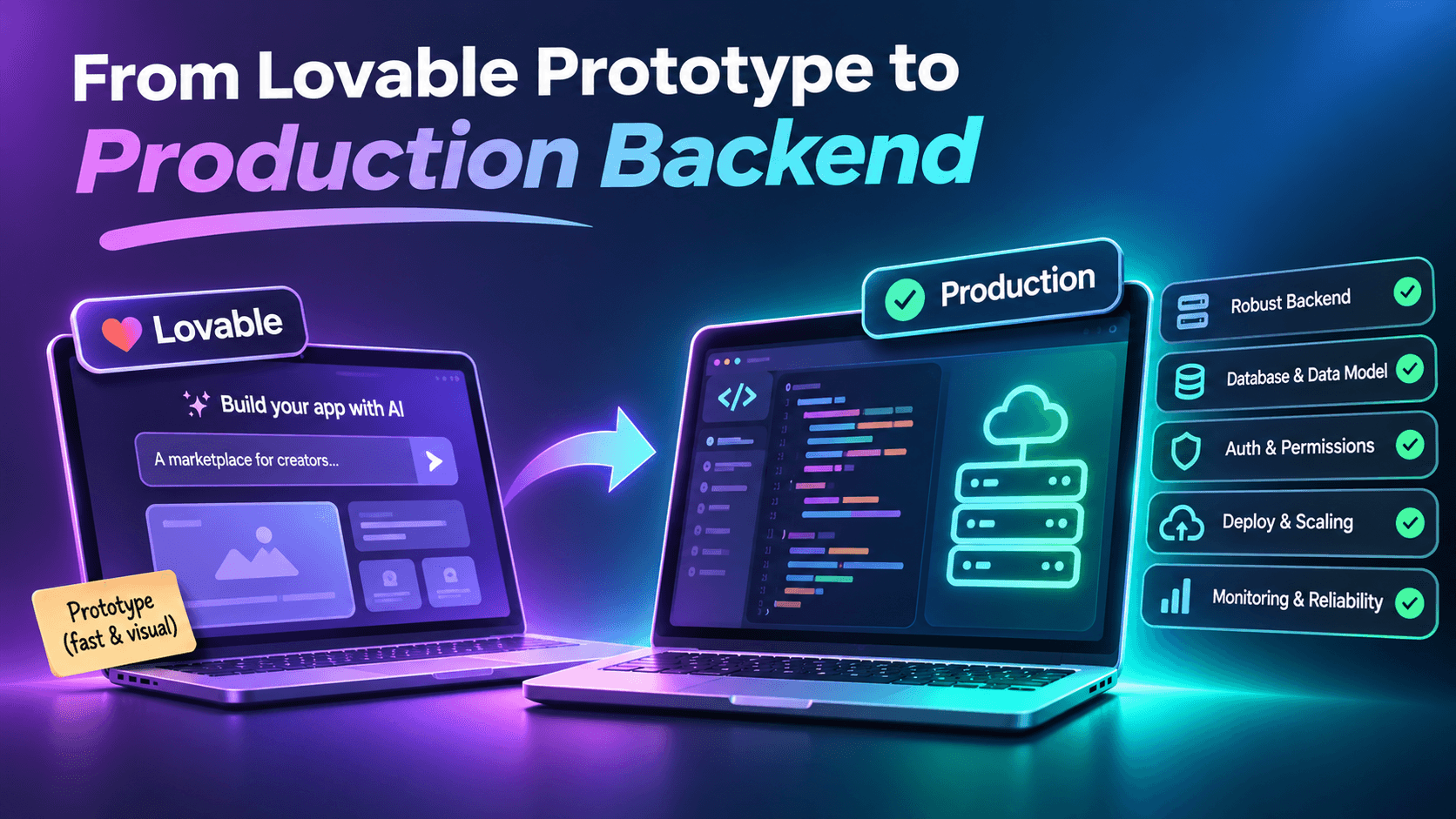
This is the pattern in our own work. For ThePokeLlama, the client came with a design built in Lovable, and we built the full backend, deployed it and ran sprint-based development. Wyzor AI followed the same pattern. The design stayed. The foundation was built properly.
How do I migrate to a new backend with live users?
Never switch everything in one night. A calm migration looks like this:
- Write down what the app does today. Flows, roles, rules, edge cases and reports. The old app is the specification.
- Back up, and restore the backup somewhere else. Prove it works before you change anything.
- Build the new layer in a separate environment, with its own database and keys, not connected to production.
- Migrate a copy of the data first. Run the migration script on the copy, compare record counts and spot-check important records.
- Run old and new side by side where you can, and route a small group of users to the new version first.
- Freeze writes briefly for the final cut-over, or use a short, announced maintenance window.
- Keep the old system available for rollback for an agreed period.
- Tell users what is changing. A short message about new login steps, if any, avoids support tickets.
Payments and authentication need special care. Reconcile your database against the payment provider before and after the move, and decide in advance how existing sessions and passwords are handled.
What should I ask a vendor before they quote a rebuild?
- Have you looked at my code, data model and payment flow? A rebuild quote without a review is a guess.
- Which parts do you propose to keep, and why? "Everything must go" needs reasons for each layer.
- How will you protect live users and data during the move? Ask for the migration and rollback plan.
- What will be written down? Documentation, an architecture diagram and a list of decisions.
- Who owns the repository, hosting accounts and keys? You should.
- How is work shown to me? Sprint demos and written updates.
- What will you not touch? Honest scope matters as much as the list of work.
- What happens if you find more? Agree how change is handled and who decides.
Where does Right.Link fit?
Our Vibe Code Rescue service covers audit, hardening and takeover of apps built with AI tools. We usually start with a free 30-minute intro call. After it, the price depends on what is needed. Before you decide to rewrite, our audit checklist shows what we look at, and the cost drivers article explains how scoping works. If something is already failing, start with the first 48 hours.
Book a free 30-minute intro call and bring your answers to the lists above. That is enough to tell you which list you are in.